 SCRIBTUM
Novaadramen Kernel (K1)
• Local deployment • No third-party data exposure • Modular AI agents
SCRIBTUMNovaadramen Kernel (K1)
• Local deployment • No third-party data exposure • Modular AI agents

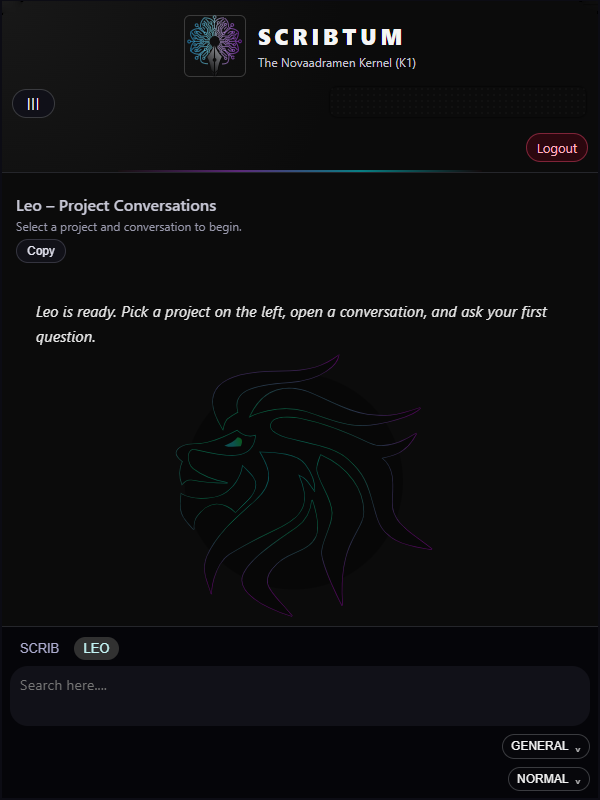
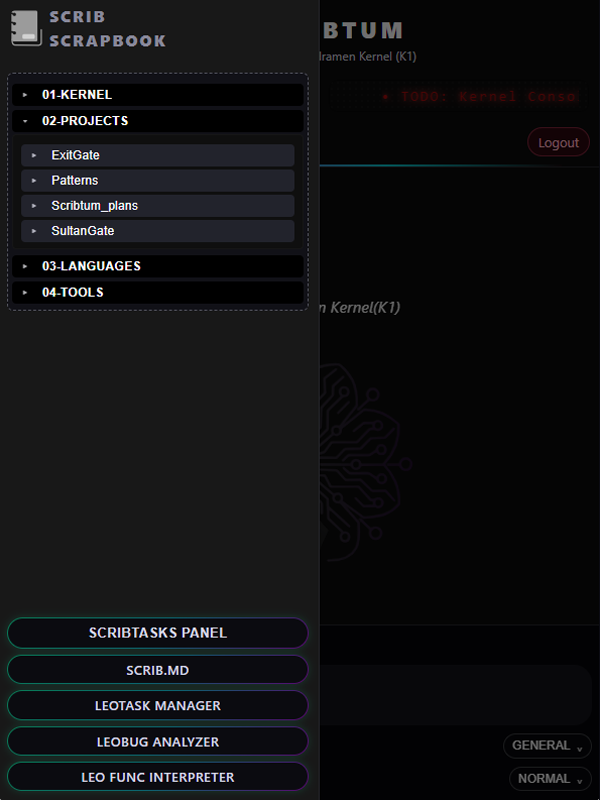
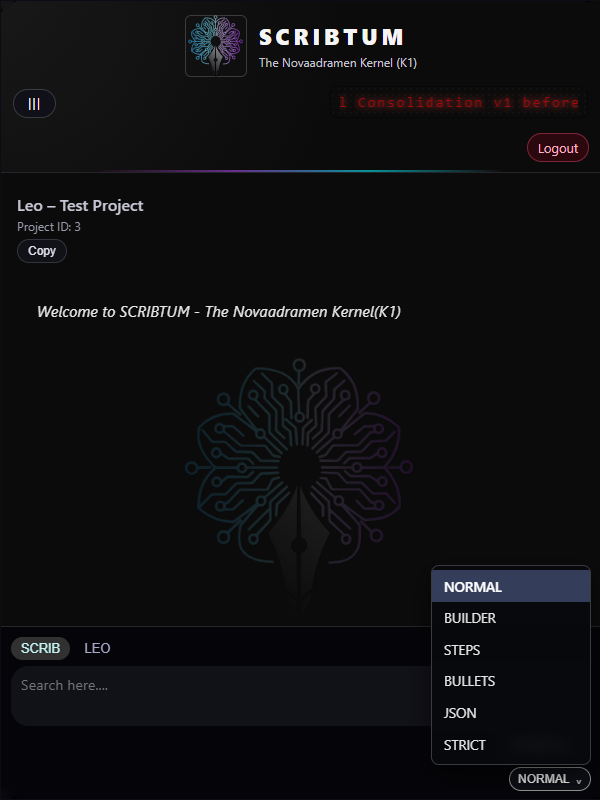
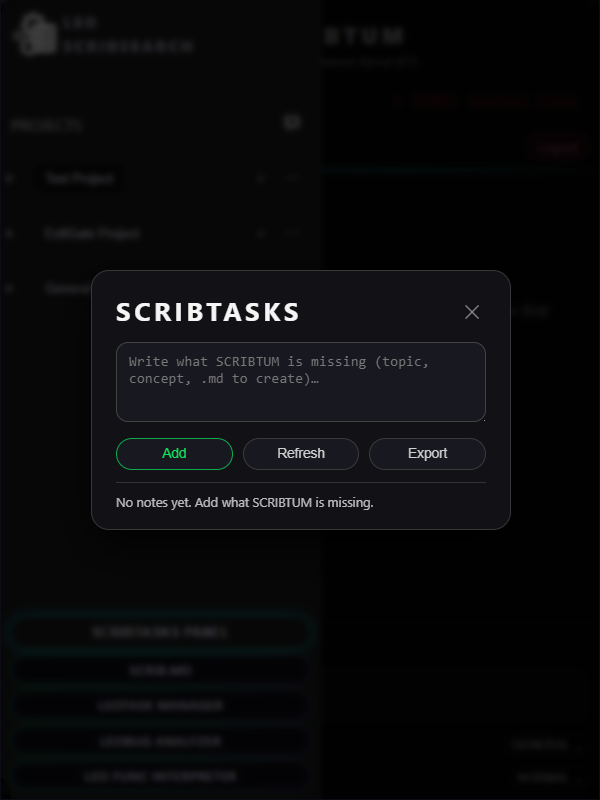
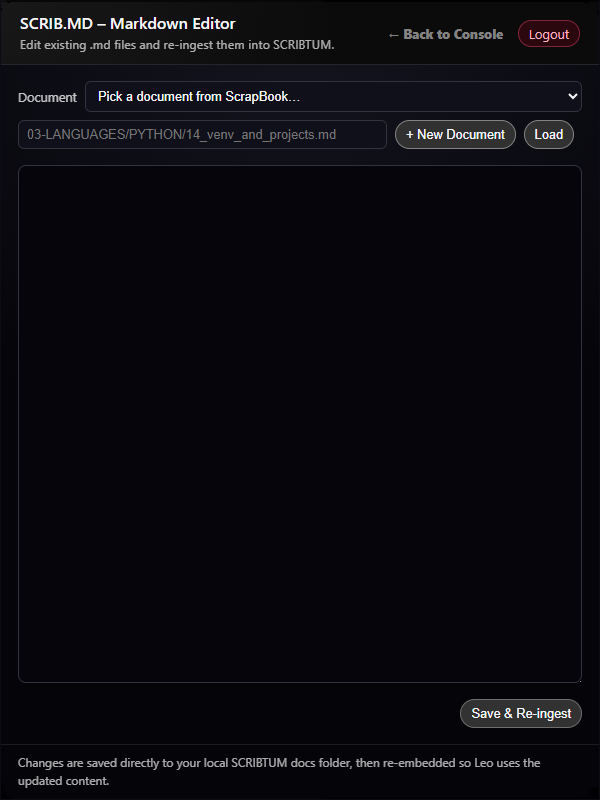
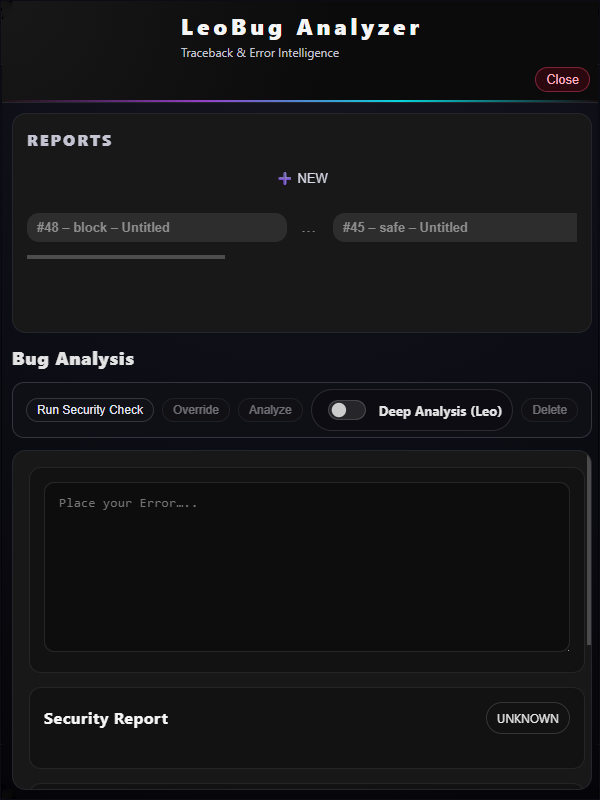
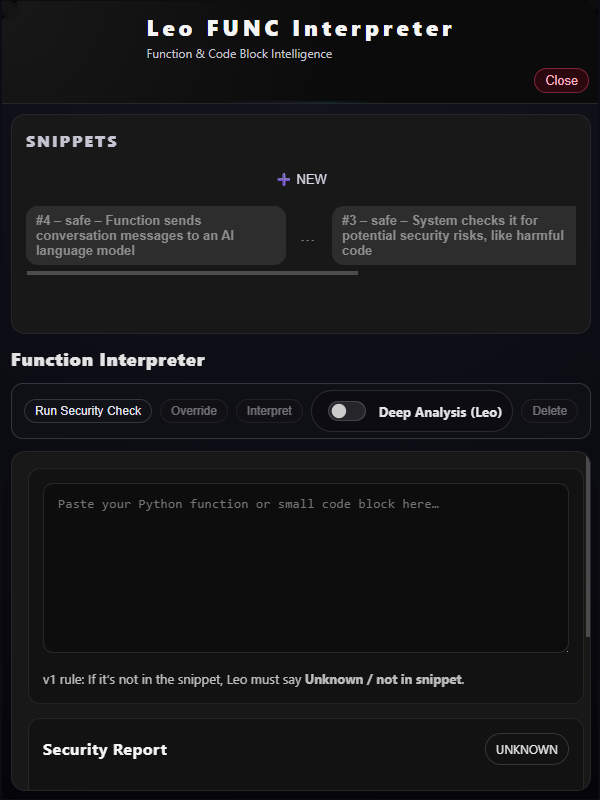
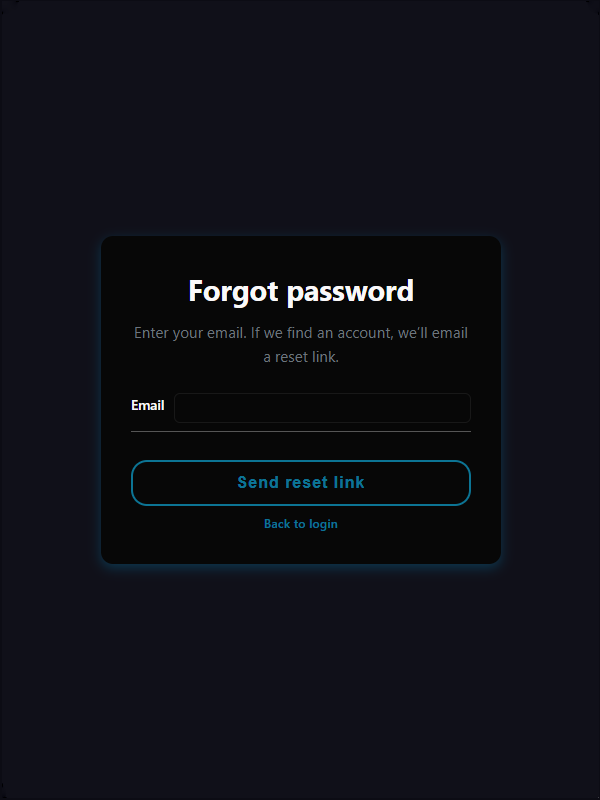
Screen
Scribtum is a local-first knowledge and reasoning system designed to store, structure, and interrogate long-term thinking.
Built using Python, SQLite, and modular AI agents, it functions as a personal knowledge operating system that combines documentation, memory, task logic, and AI-assisted reasoning within a controlled environment.
Unlike cloud-based note tools, Scribtum prioritises ownership, privacy, and structured cognition.
It serves as the backbone behind Novaadramen systems, supporting analysis, audits, debugging, and long-form decision-making across projects.
SCRIBTUM wasn’t created out of convenience, it was born out of frustration.
As my career and life became more complex, I realized something uncomfortable.
Information was everywhere, but thinking was scattered. Notes lived in apps. Plans lived in notebooks. Code lived in folders. Decisions lived in my head and nowhere permanent.
During periods of uncertainty, career transition, and system-building under pressure, I needed more than storage. I needed continuity of thought.
A place where ideas didn’t reset, lessons didn’t disappear, and hard-won clarity wasn’t lost to time or noise.
• Cloud tools felt shallow.
• AI tools felt powerful but forgetful.
• Nothing truly belonged to me.
So I started building SCRIBTUM as a private thinking environment, a system that could grow with me, remember with me, and challenge my reasoning without replacing it.
What began as a simple document store evolved into something deeper.
A structured knowledge engine where projects, decisions, tasks, mistakes, and insights could coexist, connected, searchable, and interrogated through logic rather than hype.
SCRIBTUM is the result of choosing ownership over convenience, depth over speed, and mastery over shortcuts. It is the quiet foundation behind every Novaadramen system — and the proof that real intelligence is built, not rented.
SCRIBTUM is a local-first knowledge and reasoning platform built to support long-term system thinking,
decision traceability, and technical planning.
It combines structured storage, deterministic logic, and AI-assisted reasoning into a single,
self-hosted environment.
Unlike traditional note tools or cloud-based AI systems, Scribtum is designed around data ownership,
predictability, and auditability rather than convenience or scale theatrics.
At a high level, the system consists of:
• a SQLite-backed persistence layer for documents, projects, tasks, and reasoning logs,
• a Python-based orchestration layer that governs state, dependencies, and workflows,
• and pluggable AI agents used for synthesis, interpretation, and analysis — always gated and human-controlled.
SCRIBTUM treats knowledge as a living system, not static text.
Information is structured, linked, and version-aware, allowing ideas, decisions, and outcomes to remain connected over time.
The platform currently serves as the core intelligence layer behind Novaadramen systems,
supporting architecture design, debugging workflows, HR system planning, and long-form analytical work.
Scribtum is intentionally minimal, modular, and private built to scale thinking, not noise.
SCRIBTUM is built on a deliberately conservative and transparent technical stack, prioritizing reliability, inspectability, and long-term maintainability over rapid scaling or vendor dependency.
Core Stack:
Data & Structure:
AI Integration:
Security & Ownership:
Extensibility:
Scribtum exists to solve a quiet but expensive problem:
knowledge decay.
In most organizations and personal systems, decisions are made, lessons are learned,
and systems are built only to be forgotten, duplicated, or re-argued months later.
The cost isn’t technical failure; it’s lost context.
SCRIBTUM preserves the why behind decisions, not just the output.
By retaining reasoning, assumptions, and outcomes in a structured and inspectable way,
it reduces cognitive rework and prevents teams from repeating the same analysis under different names.
While SCRIBTUM is architected for future team adoption, it currently serves as a personal knowledge and reasoning system,
a digital record of my development as a builder.
It captures ideas, decisions, experiments, and lessons as they evolve, preserving context that would otherwise be lost.
Rather than accelerating shortcuts, Scribtum slows thinking down where it matters,
allowing complex work to be revisited and strengthened over time.
In a landscape of disposable tools and ephemeral AI output, Scribtum prioritizes continuity,
because lasting value comes from what can be remembered, examined, and deliberately built upon.
Scribtum is a personal, evolving system (not a polished product).
While it is architected with future team adoption in mind, it currently serves as a private knowledge and reasoning environment
documenting my development as a system builder.
I am still an explorer on this journey, and Scribtum reflects that process of learning, testing, and refinement.
If you’re a technical leader, engineer, or architect who values structured thinking, long-term memory,
and local-first systems, your guidance, feedback, and perspective are welcome.
Thoughtful critique from experienced builders helps refine systems that are meant to last.

• Local deployment • No third-party data exposure • Modular AI agents
Live since 08 Jan 2026 —